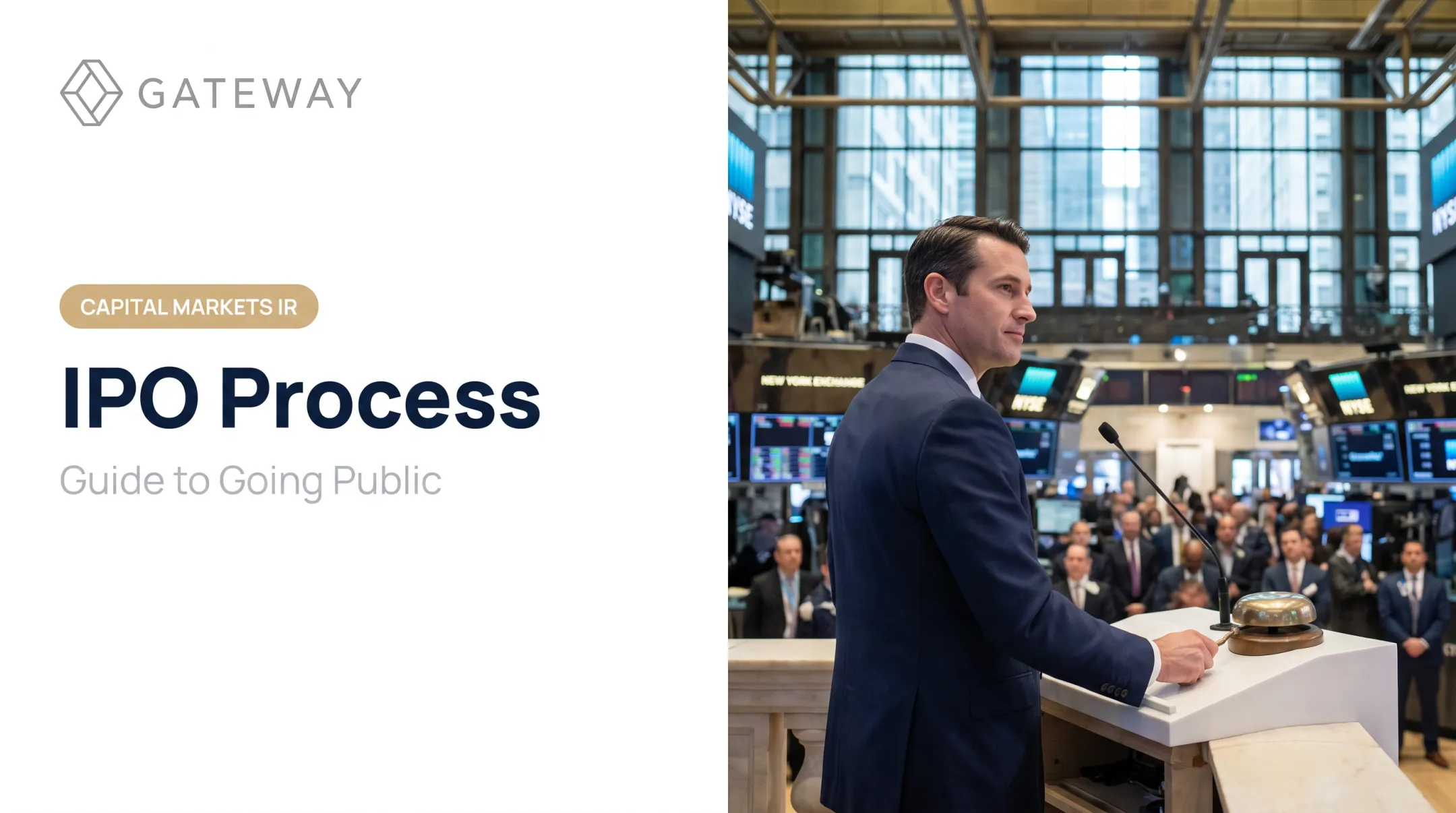

An initial public offering (IPO) is how a private company sells shares to the public for the first time, becoming a publicly traded entity on an exchange like the Nasdaq or NYSE. It's a legal, financial, and communications undertaking that typically spans well over a year.
This article breaks down what actually happens during an IPO, the real trade-offs companies face when going public, and what individual investors should know before buying in. Whether you're running a growth company weighing this decision or an investor curious about the process, you'll find a straightforward answer here.
Key Takeaways
- An IPO converts a private company into a publicly traded one by selling shares on an exchange for the first time
- The process runs 12-18 months and involves underwriters, SEC filings, and investor roadshows
- Going public brings capital and visibility, but also real costs, dilution, and disclosure obligations
- Retail investors face allocation limits and volatility; research the prospectus before buying
- A credible equity story matters as much as financial metrics for a successful listing
What Is an IPO?
An IPO is the process by which a private company offers shares to the public for the first time, transitioning from private ownership to a publicly traded entity. Once shares list on an exchange, anyone can buy or sell them.
Companies pursue IPOs for several reasons:
- Raising capital for growth, R&D, or debt reduction
- Providing liquidity to early investors, founders, and employees holding equity
- Funding acquisitions using publicly traded stock as currency
- Increasing brand visibility and credibility with customers and partners
IPOs aren't the only path to going public. Direct listings skip the underwriter-led share sale entirely, letting existing shareholders sell directly on the exchange. SPACs (special purpose acquisition companies) merge a private company into an already-public shell company, bypassing the traditional S-1 process. Both routes trade certain protections and capital-raising benefits for speed or reduced fees.
Can a Small Company Go Public?
Yes. Smaller and emerging growth companies can go public if they meet exchange listing standards, though they often face more scrutiny than larger issuers.
The SEC's emerging growth company (EGC) designation applies to companies with less than $1.235 billion in prior-year revenue. It eases disclosure requirements; it does not replace exchange rules. EGC accommodations include:
- Two years of audited financials instead of three
- Relief from certain accounting changes
- Ability to test the waters with institutional investors before filing publicly
Exchange listing standards are separate and non-negotiable. Nasdaq's Capital Market tier, for example, offers multiple qualification paths:
- Equity standard: $5 million in stockholders' equity and $15 million in public float
- Market-value alternative: $4 million in equity and $50 million in listed securities value
The NYSE's thresholds run higher, generally requiring $40 million in public market value and 400 round-lot holders.
Meeting these tests gets a company listed. Long-term success depends on readiness after the bell rings, not eligibility alone.
The IPO Process: Step by Step
Going public follows a fairly consistent sequence, though the calendar can stretch or compress depending on market conditions and company preparation.
- Select underwriters. Investment banks conduct due diligence, help structure the offering, and commit to distributing shares to institutional and retail buyers.
- File the S-1 registration statement. This SEC filing includes a preliminary prospectus covering financials, risk factors, and business details. It's publicly available through EDGAR.
- Develop the equity story and run the roadshow. Management pitches institutional investors on the business, market opportunity, and valuation case. A clear equity story supports pricing confidence; a weak one leaves demand uncertain. Firms like Gateway Group help companies shape that narrative for the roadshow.
- Price and allocate shares. Underwriters set the final offering price based on roadshow demand, then allocate shares between institutional and retail investors.
- List and manage post-IPO obligations. Trading begins on listing day. Ongoing SEC reporting, investor relations, and exchange compliance then become permanent parts of operating as a public company.

PwC's 2025 guidance suggests the full runway from readiness assessment through listing spans 12 to 18 months. The S-1 filing to listing window often moves faster: roughly 85% of companies in PwC's IPO cost analysis went public within six months of their initial SEC filing.
Pros and Cons of Going Public
Going public reshapes a company's financial structure, governance, and public profile. Weigh both sides carefully before committing.
Pros:
- Access to growth capital without taking on debt
- Increased brand visibility and third-party credibility
- Liquidity for founders, early investors, and employees
- Ability to use publicly traded stock for acquisitions
- Stronger equity compensation for attracting and retaining talent
Cons:
- Underwriting fees typically 6%–8% of the offering price, per Renaissance Capital's IPO glossary
- Legal, accounting, and compliance costs averaging another 4%–7% of gross proceeds
- Loss of some operational control and board independence
- Ongoing regulatory scrutiny and quarterly earnings pressure
- Dilution of existing ownership stakes
A first-day stock pop doesn't guarantee smooth sailing. Renaissance Capital's 2025 U.S. IPO review found larger IPOs (raising $100 million-plus) averaged a 21% return from offer price, while the broader IPO pool averaged just 1%. Individual results varied widely, from a 23% gain for one company to a 27% decline for another. That dispersion is a cautionary note for anyone assuming an IPO automatically means a payday.

Investing in an IPO: What Individuals Should Know
Can You Make Money From an IPO?
Returns vary widely. Offer pricing, market conditions, and company fundamentals all matter, and there is no universal outcome.
Short-term, first-day gains have been strong recently. Jay Ritter's IPO data shows a mean first-day return of 29.3% in 2025, though over 33% of IPOs still finished their first day in negative territory.
Longer-term results are weaker. Three-year buy-and-hold returns, measured from the first closing price rather than the offer price, showed a market-adjusted average of -20.5%.
A quick illustration: Google's 2004 IPO priced at $85 per share. Adjusting for a 2014 2-for-1 split and a 2022 20-for-1 split, and using a recent Alphabet Class C price near $334, a $10,000 investment at IPO would be worth roughly $1.57 million today (about 157 times the original stake).
That outcome is extreme and visible only in hindsight, not a typical IPO result.
Is Investing in an IPO Safe for Beginners?
Not inherently. The SEC warns that IPO trading prices can differ sharply from the offering price, and that prices often fall once underwriter price support ends.
Key risks for beginners:
- High volatility from limited trading history and hype-driven demand
- Lock-up expirations (often 180 days post-IPO) that can flood supply and pressure the price
- Less public information than companies with years of reporting history
Beginners should read the prospectus in full and consider waiting until trading stabilizes before buying in.
How Can I Get an IPO Allocation, and Can I Buy Before It Goes Public?
Retail investors generally cannot buy shares before the IPO unless they have access through a specific brokerage program or private market platform. Most pre-IPO shares go to institutional and high-net-worth clients.
To participate at listing, retail investors typically need to:
- Use a brokerage that participates in IPO allocations
- Complete an eligibility questionnaire confirming they aren't a "restricted person" under FINRA rules
- Submit an Indication of Interest, which signals demand but doesn't guarantee shares

Even with these steps, allocation is never guaranteed. Brokers report aggregate retail demand, but individual investors often receive partial or zero allocations.
Should Your Company Consider an IPO? (How to Prepare)
Readiness signals go well beyond meeting exchange listing minimums. Companies that navigate the IPO process successfully typically show:
- A strong, experienced management team capable of operating under public scrutiny
- Predictable, well-documented financials and internal controls
- A scalable business model with a clear path to growth
- A well-defined addressable market that investors can understand quickly
A credible equity story matters just as much as the numbers. Investors need a coherent narrative connecting the company's strategy, market position, and financial trajectory—not just a compliant balance sheet.
That is where Gateway Group works alongside management teams: refining the equity story, strengthening investor communications, and building the IR foundation that carries a company well past listing day.
Rushing the timeline is a common misstep. A company that lists before its financial controls, reporting infrastructure, and leadership bench are ready often struggles publicly, facing the same disclosure requirements as its more prepared peers but without the internal systems to meet them smoothly.
Frequently Asked Questions
Can a small company go public?
Yes, if it meets exchange listing standards like Nasdaq's or NYSE's equity and float requirements. However, meeting minimum eligibility doesn't guarantee long-term success. Operational readiness matters more.
Can you make money from an IPO?
Returns vary and depend on offer pricing, market timing, and company fundamentals. Some IPOs deliver strong first-day pops; others decline sharply, so there's no guaranteed outcome.
Is investing in an IPO safe for beginners?
Not automatically. IPO stocks can be volatile, with limited trading history and prices often falling after underwriter support ends. Beginners should read the prospectus and consider waiting for trading to stabilize.
Can I buy an IPO before it goes public?
Generally, no. Pre-IPO shares are typically reserved for institutional and accredited investors, though some brokerages offer limited retail access programs.
How can I get an allocation in an IPO?
You'll need a brokerage that offers IPO access, complete an eligibility questionnaire, and submit an Indication of Interest. Even then, allocation isn't guaranteed and is often partial.
What would $10,000 invested in Google's IPO be worth today?
Adjusting for stock splits since Google's 2004 IPO at $85 per share, $10,000 would be worth roughly $1.57 million today based on a recent Alphabet share price. This is illustrative only and not representative of typical IPO outcomes.