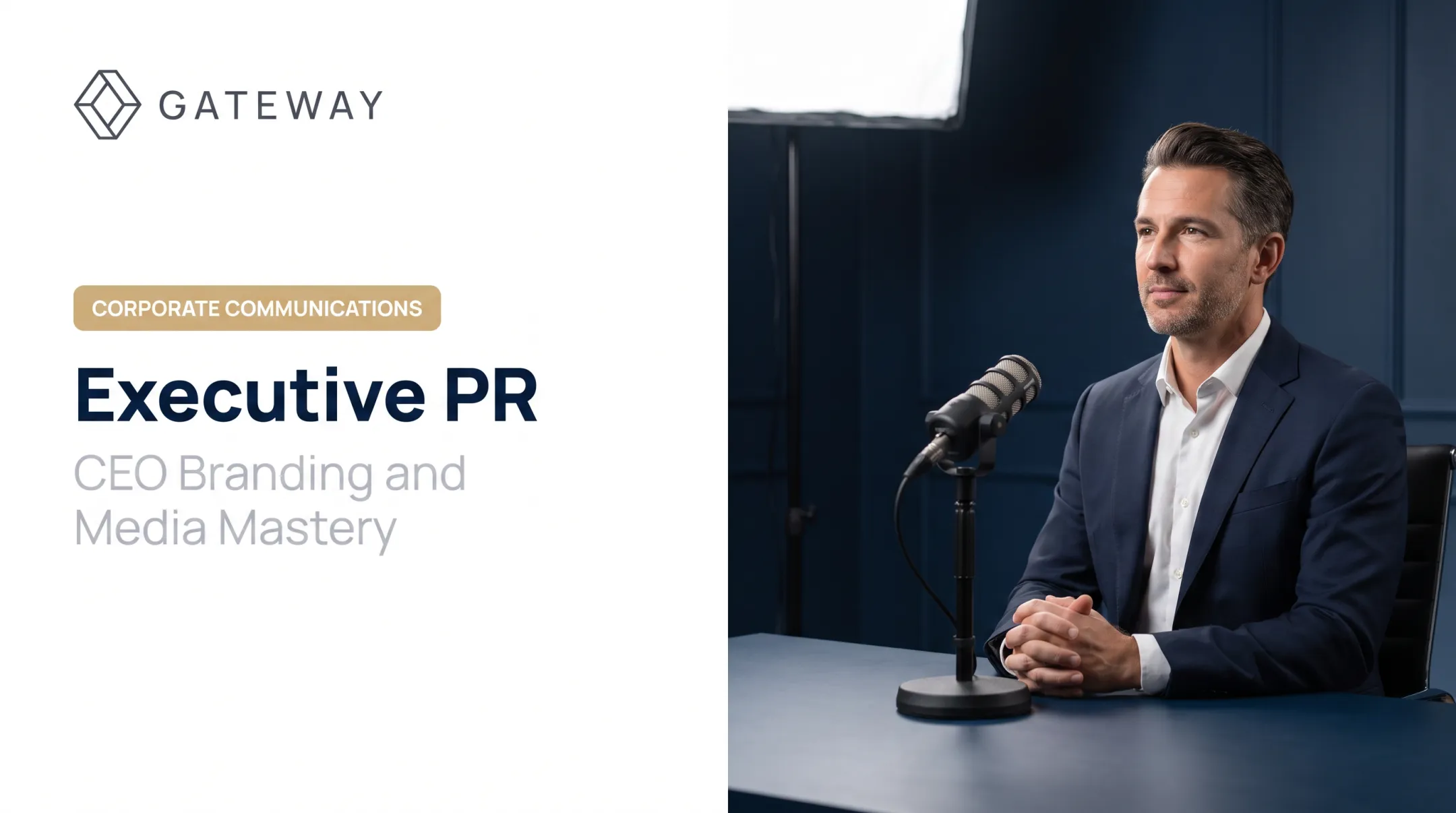

CEO branding isn't about posting daily on LinkedIn or chasing personal popularity. It's the intentional development of a leader's identity, positioning, and public narrative in service of business goals—growth, fundraising, recruiting, and market trust.
This article walks through the foundation, the strategy, the channels, a 90-day launch plan, and how to measure results without leaning on vanity metrics.
Key Takeaways
- CEO branding connects what a leader is known for to specific business outcomes.
- Strong CEO brands blend authentic identity, consistent messaging, and stakeholder-specific communication.
- Effective strategies prioritize relevant audiences over follower counts.
- A 90-day sequence covering audit, positioning, content, and activation gets programs off the ground.
What CEO Branding Means and Why It Drives Growth
What CEO Branding Actually Includes
Every CEO has a reputation, whether they manage it or not. CEO branding is the deliberate version: shaping identity, values, leadership narrative, and visibility around specific business objectives.
This differs sharply from influencer marketing. Influencer activity optimizes for attention and reach. CEO branding builds authority and trust with the specific audiences who make business decisions—investors, customers, employees, and partners.
Why CEO Branding Matters to Growth
Research from FTI Consulting's 2023 CEO Leadership Redefined study, which surveyed 800 US employees and 250 global institutional investors, found that CEOs play an outsized role in company reputation. That reputation directly affects decisions to buy from, invest in, or work for a company.
A credible CEO presence also does something practical: it translates complex strategy into a human, memorable story. That matters most for technical or capital-intensive businesses where the "why" isn't obvious at a glance.
CEO Branding Versus Related Disciplines
These terms often get used interchangeably, but they serve different purposes:
- Corporate branding shapes perception of the organization as a whole
- Personal branding covers an individual's skills, values, and character broadly
- Thought leadership establishes expertise through content and speaking
- Reputation management influences what key audiences think about an organization
- CEO branding sits at the intersection—using identity and visibility to advance company goals specifically
CEO branding should complement the corporate brand, not compete with it, especially when a company communicates with investors, employees, and media simultaneously.
Who Benefits Most
Executive credibility carries disproportionate weight for:
- Private growth companies raising capital
- Emerging growth companies and small- and mid-cap public issuers
- Founder-led businesses
- Companies preparing for IPOs or SPAC transactions
It matters most during high-stakes periods: fundraising, a public listing, an M&A transaction, or a crisis.
The Risk of Visibility Without Strategy
Many CEOs fall into the "tactics trap": posting more, speaking more, and appearing in more media before defining what they should be known for.
What actually builds trust is executive visibility, authentic communication, and simplified storytelling—not activity volume. Inconsistent or overly promotional visibility confuses audiences rather than building confidence.

The Foundations of a Credible CEO Brand
Audit Current Perception First
Before creating new visibility, understand what already exists:
- Search results and LinkedIn profile
- Media coverage and speaking appearances
- Company bio, investor materials, public comments
- Qualitative feedback from employees, customers, investors, and board members
This surfaces gaps between how the CEO wants to be perceived and how key stakeholders actually describe them.
Define Differentiation and Positioning
Those gaps set up the core question: What should this CEO be known for? A useful answer avoids vague claims like "visionary" or "innovative." It connects the CEO's experience to a specific market conversation, customer problem, or industry shift—something a competitor can't easily copy.
Build a Narrative That Connects Leader to Company
Positioning only sticks when it sits inside a clear leadership narrative. Include:
- A formative experience that shaped their perspective
- A core business insight or conviction
- Values that guide hard decisions
- Strategic vision for the company
- Proof points that demonstrate credibility
- The change they are trying to create
That story should flex across an investor deck, employee town hall, media interview, and LinkedIn post—without sounding rehearsed in every version.
Evaluate Common Frameworks
If you want a structure for that narrative work, a few common frameworks can help—as planning tools, not formulas:
- Seven Pillars (Purpose, Values, Clarity, Strengths, Energy, Legacy, Ownership) — a personal-brand framework popularized through Forbes Coaches Council
- Three C's — clarity, consistency, and constancy, as defined in a separate Forbes personal branding piece
- 3-7-27 rule — a mental model (not an empirical law) suggesting it takes 3 exposures to notice a brand, 7 to remember it, and 27 to build real trust
Pull only the ideas that clarify identity or structure communication, and skip the rest.
Create a Stakeholder and Message Architecture
Map priority audiences against what each one needs to believe:
| Audience | What They Need to Understand |
|---|---|
| Customers | Why this company solves their problem better |
| Investors | The equity story and growth thesis |
| Employees | Where the company is headed and why it matters |
| Partners | Why collaboration creates mutual value |
| Media | What makes this leader worth quoting |
A small set of message pillars keeps those audiences hearing one credible CEO story—consistent in public, without sounding scripted.

CEO Branding Strategies That Support Business Growth
Anchor the Narrative to Business Priorities
Every branding objective should tie to something concrete: entering a new market, improving investor awareness, attracting talent, or supporting a transaction. Select proof points (real milestones, customer outcomes, or leadership decisions) that demonstrate the narrative instead of just asserting it.
Set clear boundaries early: what's personal opinion, what's company messaging, and what needs review by legal or investor relations before it goes public.
Develop Two to Four Thought-Leadership Pillars
Build content pillars where the CEO's expertise, company priorities, and audience questions intersect. Balance expert content with humanizing material: lessons learned, decision-making principles, and culture commitments, without irrelevant personal oversharing.
Each pillar should generate multiple formats:
- LinkedIn posts and articles
- Podcast and media interviews
- Conference remarks and webinars
- Investor presentations and employee updates
That same multi-format discipline is how executive LinkedIn management turns a CEO profile into a practical channel for investors, customers, and other stakeholders—not a static bio page.
Choose Channels Based on Audience and Objective
Don't spread the CEO across every platform. Start with one or two channels where priority stakeholders already spend time. A 2024 Edelman-LinkedIn B2B Thought Leadership Impact Report found 54% of decision-makers and C-suite executives spend an hour or more per week reading thought-leadership content, which is why channel fit matters more than channel count.
Test channel fit against:
- Audience relevance
- Outlet credibility
- Executive availability
- Compliance requirements
- Ability to sustain a consistent cadence
Use Media, Speaking, and Third-Party Credibility Strategically
Targeted media relations, podcast appearances, and conference panels reinforce a CEO's position when the opportunity fits. Prepare the basics in advance: a media biography, core talking points, an interview briefing document, and approved headshots.
Amprius Technologies' Senior Director of Marketing, Scott Zafiropoulo, credited Gateway's investor relations and marketing communications guidance with raising visibility and opening new audience connections. The gains came from targeted outreach, not publicity volume.
Integrate CEO Branding with IR, PR, and Corporate Branding
CEO messaging needs to align with the company's equity story, press announcements, and crisis response plan. A CEO saying one thing while the investor deck says another erodes trust fast.
That alignment is easier when IR, PR, digital, and transaction communications work from the same playbook. Gateway Group, founded in 1999 and shaped by more than 500 client engagements, supports growth companies and small- to mid-cap issuers that need one consistent narrative across investors, employees, and media.

The First 90 Days: A Practical CEO Branding Launch Plan
Treat the first quarter as a structured launch, not a vague intention. This sequence moves from positioning to assets to visible activity without overloading the CEO's calendar.
Days 1-30: Audit, Alignment, and Positioning
Clarify how the CEO is seen today and which business results the brand must support.
- Complete the perception audit and identify priority stakeholders
- Define the business outcomes the brand should support
- Select the CEO's differentiation and two to four content pillars
- Build a message map with core narrative, proof points, and an escalation process for sensitive topics
Days 31-60: Develop Assets and Prepare the Content Engine
With positioning set, upgrade the materials and workflow that will carry the message.
- Update the CEO bio, LinkedIn profile, and speaker materials
- Refresh photography and the company leadership page
- Build a realistic editorial calendar that repurposes one insight into multiple formats
- Assign responsibilities for approvals, publishing, and tracking
Days 61-90: Activate, Engage, and Refine
Shift from preparation to public activity, then tighten the plan using early signal.
- Launch the priority channel with a consistent cadence
- Pursue a small number of relevant speaking or media opportunities
- Connect CEO communications to actual company milestones
- Review early indicators (inbound inquiries, engagement quality, media relevance) and refine the next quarter's plan

How to Measure CEO Branding Without Relying on Vanity Metrics
Start with a baseline: document current search visibility, media presence, inbound interest, and stakeholder descriptions before launch.
Then organize metrics into two buckets:
Leading indicators:
- Reach among priority audiences (not total followers)
- Message recall in stakeholder conversations
- Media invitations and profile visits
Business indicators:
- Qualified leads and partnership discussions
- Investor meetings and recruiting interest
- Transaction support opportunities
The same Edelman-LinkedIn research found that 42% of thought-leadership producers still measure effectiveness through website or social traffic alone, and 19% have no measurement process at all.
That is a weak signal for work meant to influence buying and investing decisions.
Don't optimize for follower count or impressions—they don't prove credibility with the audiences that drive growth. Attribution is often indirect, so pair quantitative tracking with stakeholder feedback and periodic perception reviews.

Conclusion: Turn Executive Visibility Into a Strategic Growth Asset
Effective CEO branding combines a clearly defined identity, a credible narrative, disciplined visibility, and tight alignment with company growth strategy. Treat it as infrastructure for trust, not a side project or vanity exercise.
Start small: complete a perception audit, pick one priority audience and one business objective, and run the first 30 days of the plan. Prove the model works before expanding the CEO's public presence.
Frequently Asked Questions
What branding frameworks should CEOs know (7 pillars, 3 C's, 3-7-27 rule)?
Each framework addresses a different piece: the seven pillars clarify identity, the three C's (clarity, consistency, constancy) guide messaging discipline, and 3-7-27 models how repeated exposure builds trust. Treat them as planning tools, not guaranteed formulas; definitions vary by source.
What should a CEO do in the first 90 days?
Start with a perception audit and positioning work (days 1-30), then build content assets and an editorial calendar (days 31-60), then activate channels and measure early results (days 61-90).
What is the difference between CEO branding and corporate branding?
Corporate branding shapes perceptions of the organization; CEO branding shapes perceptions of its leader. When aligned, both reinforce the same trust and differentiation story.
How can CEOs measure whether branding is driving business growth?
Track qualified inbound opportunities, investor and customer engagement, media and speaking invitations, and recruiting signals—not follower counts. Combine data with stakeholder feedback for a fuller picture.
How long does it take to see results from CEO branding?
Foundational improvements, like a stronger bio or LinkedIn presence, can appear within weeks. Building real authority and measurable business impact typically takes consistent effort over multiple quarters.